MedReview Insights

Latest Articles & Counselling Guides

Stay updated with recent NEET PG trends, choice filling algorithms, and verified stipend matrices.

When Saviours Suffer: Why So Many Doctors-to-Be Are Taking Extreme Steps
Aug 10, 2026

When Saviours Suffer: Why So Many Doctors-to-Be Are Taking Extreme Steps

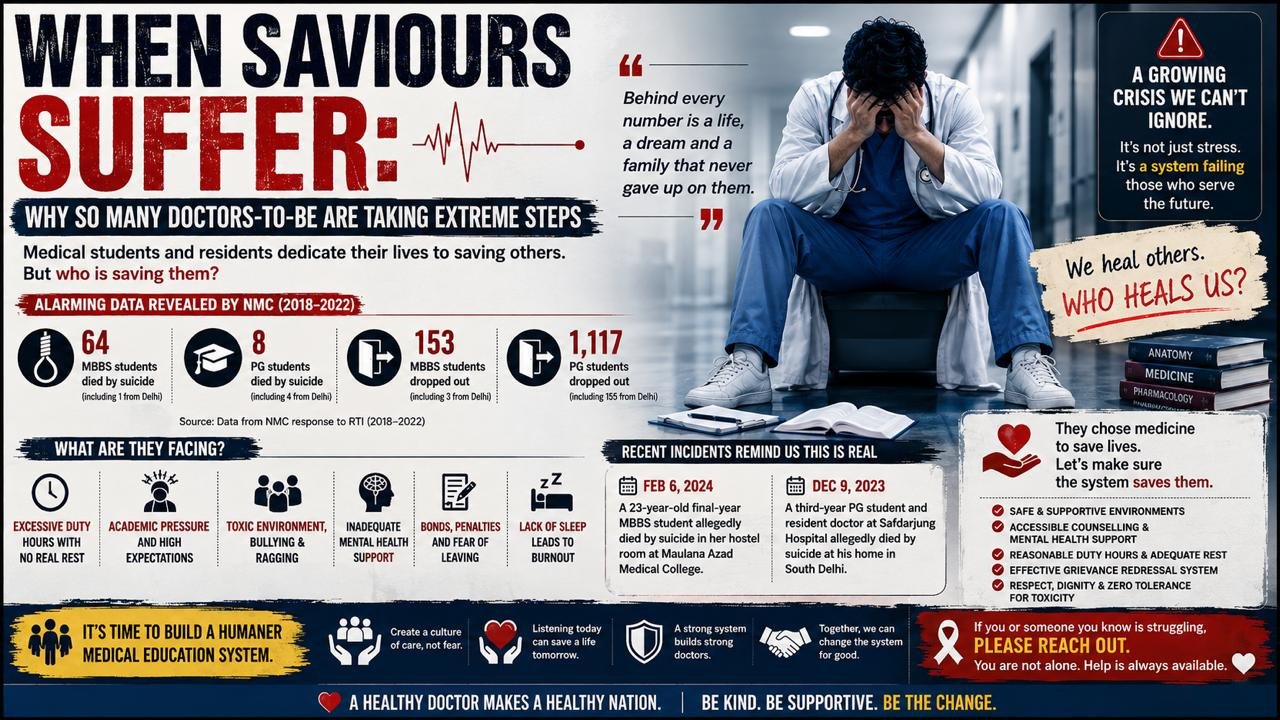
New Delhi: The medical profession is often described as one of the noblest professions, built around saving lives and caring for others. But behind the white coat, stethoscope and years of rigorous training, a growing number of medical students and postgraduate residents are struggling with an increasingly difficult reality.Data revealed by the National Medical Commission (NMC) in response to an RTI application has brought this crisis into sharp focus. According to the reported data, 64 MBBS students and 8 postgraduate medical students died by suicide between 2018 and 2022. During the same period, 153 MBBS students dropped out of medical colleges, while 1,117 postgraduate students dropped out across India.The figures are not merely statistics. Each number represents a student, a family, a career and a life that was lost or disrupted.The Pressure Begins Long Before ResidencyMedical education demands years of intense academic preparation. Students spend years preparing for competitive examinations, followed by demanding undergraduate training and, for those pursuing specialisation, another round of highly competitive entrance examinations.But academic pressure is only one part of the problem.According to doctors and resident representatives quoted in the report, medical students and residents frequently face long working hours, inadequate rest, hostile working environments, academic pressure, difficult relationships with seniors and a lack of effective institutional support.Postgraduate residents may be required to work extremely long shifts, sometimes stretching to 36 hours or more, while simultaneously managing clinical responsibilities, academic requirements, examinations and expectations from multiple levels of the hierarchy.The result can be a dangerous combination of physical exhaustion, emotional burnout and psychological distress.When Training Becomes SurvivalThe postgraduate years are supposed to be a period of learning, professional development and clinical growth.Instead, for some residents, the experience can become one of simply trying to survive the next duty, the next examination, the next night shift or the next interaction with a senior.A stressful environment becomes even more difficult when students feel that they have nowhere to turn.The report highlights concerns regarding inadequate counselling and support mechanisms for students who may already be struggling. Without accessible and confidential support systems, students at risk may continue suffering silently.There is also the issue of language and cultural barriers. Students come from different states, regions and linguistic backgrounds. Adjusting to a new institution, a new city, a new language and an unfamiliar academic environment can add another layer of stress.The Problem Is Bigger Than Academic PressureIt is easy to blame medical students' distress entirely on examinations or workload. But the problem is far more complex.The environment in which medical education takes place matters enormously.A system characterised by excessive working hours, inadequate rest, humiliation, bullying, toxic hierarchy, poor infrastructure, academic pressure and limited avenues for grievance redressal can gradually affect a student's mental well-being.The Federation of Resident Doctors' Association (FORDA) has also pointed towards the complex issues affecting residents beyond academic pressures alone.Medical education inevitably demands hard work. Long hours and stressful situations are sometimes unavoidable in clinical training. But hard work should not mean sacrificing basic human dignity, sleep, safety and psychological well-being.Recent Incidents Make the Concern Even More UrgentThe concern is not limited to historical data.The report also referred to recent incidents involving young medical professionals.In February 2024, a 23-year-old final-year MBBS student allegedly died by suicide in a hostel room at Maulana Azad Medical College.In December 2023, a third-year postgraduate resident doctor at Safdarjung Hospital allegedly died by suicide at his home in South Delhi.Such incidents force an uncomfortable question upon the medical community:How can a system designed to train people to save lives fail to protect the lives of those being trained?The Bond and the Fear of LeavingAnother concern highlighted in the report relates to the bonds imposed on medical students and residents in some institutions and states.Students who discontinue their courses may face substantial financial penalties or restrictions on appearing for examinations for a certain period.While bonds may have been introduced for legitimate policy reasons, the question is whether a student who is already struggling should be effectively trapped in an environment that they feel unable to continue in.There must be a distinction between encouraging students to complete their education and forcing vulnerable students to remain in an unbearable situation.As one doctor quoted in the report pointed out, students should have a reasonable exit mechanism if they genuinely cannot continue.Where Is the Institutional Responsibility?The responsibility cannot be placed entirely on the individual student.If dozens of students are dying by suicide and more than a thousand postgraduate students are dropping out, the response cannot simply be to tell students to "be stronger."The medical education system must examine itself.Institutions need mechanisms through which students can confidentially report bullying, harassment, excessive workload and other concerns without fear of retaliation.There should also be meaningful access to professional psychological support, confidential counselling, adequate rest, reasonable working conditions and effective grievance redressal mechanisms.Most importantly, these mechanisms must be accessible in reality, rather than existing only on paper.We Need to Stop Normalising ToxicityOne of the most dangerous phrases in medical education is:"We went through it, so you should go through it too."Previous generations may have tolerated excessive working hours, humiliation or toxic environments. That does not make those practices necessary or acceptable.Medicine should teach resilience, but resilience should not be confused with the ability to tolerate abuse.A demanding profession can still be humane.A resident can be expected to work hard without being degraded.A student can be held accountable without being humiliated.A doctor can be trained rigorously without being broken in the process.Doctors Are Saviours TooWe often teach doctors to recognise warning signs in patients.We tell them to identify symptoms early, intervene quickly and prevent tragedy whenever possible.Perhaps it is time to apply the same principle to our own profession.A struggling medical student is not a weak student.A burnt-out resident is not an incompetent doctor.Asking for help is not a failure.Leaving a toxic environment is not a failure.The medical education system must create an environment where seeking help is seen as a sign of awareness rather than weakness.The numbers revealed by the NMC should not simply become another statistic quoted in newspaper articles. They should become a reason for serious institutional introspection.Because behind every suicide statistic is a person who once entered medical college with dreams of becoming a doctor.The people who are training to save lives deserve a system that cares about saving theirs too.
NEET PG Residents Leaving Their Seats Midway: What Are We Missing?
Aug 10, 2026

NEET PG Residents Leaving Their Seats Midway: What Are We Missing?

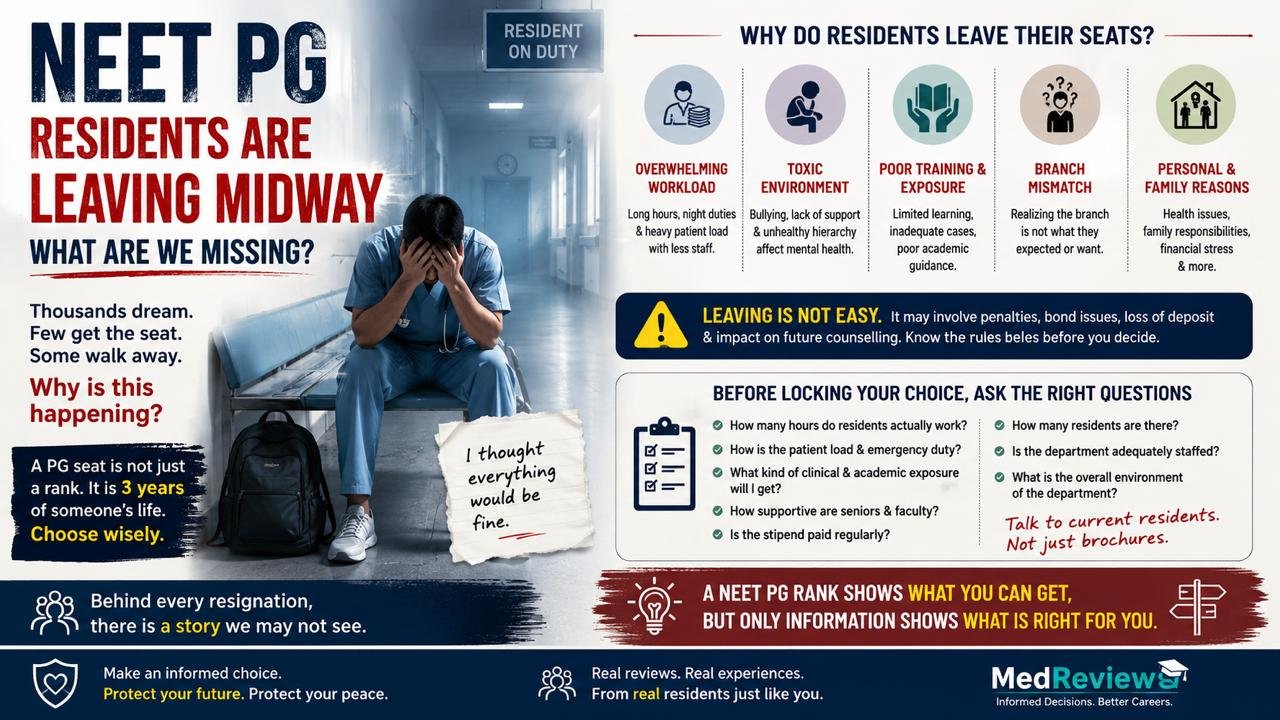
Every year, thousands of doctors work relentlessly to secure a postgraduate seat through NEET PG. After years of preparation, sleepless nights and immense competition, getting an MD, MS or DNB seat is often considered the fulfilment of a long-awaited dream. Yet, despite the intense competition for these seats, some residents are choosing to leave their postgraduate courses midway. This raises an important question: Why are doctors walking away from seats that many aspirants would do anything to get?The answer is not always as simple as saying that the resident made a wrong choice. For some, the reality of residency turns out to be very different from what they expected before counselling. The workload may be overwhelming, clinical exposure may be inadequate, academic teaching may be poor, or the department environment may be toxic. In other cases, students realise only after joining that the branch they selected does not suit their interests, personality or long-term career goals. A branch may look attractive on paper because of its rank, reputation or earning potential, but the actual day-to-day experience of residency can be completely different.The bigger problem is the information gap before counselling. Candidates often choose colleges and branches based on cutoff ranks, reputation, online information and advice from friends or counsellors. However, they may have very little understanding of what residency actually looks like inside a particular department. How much hands-on exposure will they receive? How many night duties are there? How supportive are the seniors and faculty? Is the stipend paid on time? What is the workload? Will they get adequate academic and procedural exposure? These are questions that can significantly influence whether a resident survives and thrives in a department, yet they are often difficult to answer before joining.At the same time, leaving a PG seat should not be treated casually. Depending on the counselling authority, institution, state and stage of admission, resignation can have financial, contractual and administrative consequences. A resident should therefore understand the applicable rules, bonds and penalties before taking such a decision. But we also need to recognise that not every resident who leaves a seat is a seat blocker. Sometimes leaving is the consequence of a genuine mismatch, inadequate training, serious personal circumstances or an environment that the resident cannot reasonably continue in.Ultimately, the solution is not simply to make it impossible for doctors to leave postgraduate training. The real solution is better information before the choice is made. Aspirants should speak to current residents and alumni, ask specific questions about workload, training, academic exposure and department culture, and look beyond the college's name or closing rank. A NEET PG rank tells you what seat you can get; it does not tell you where you will be happy or successful for the next three years. A postgraduate seat should be an informed career choice, not a decision made simply because "seat mil rahi hai, le lo."If you want, I can also make this more emotional and hard-hitting for your MedReview/Medical Drafts audience, while keeping it suitable as a website blog.

1,120 PG Doctors Left Their Courses in Five Years: But How Many Had to Pay the Price?
Aug 10, 2026

1,120 PG Doctors Left Their Courses in Five Years: But How Many Had to Pay the Price?

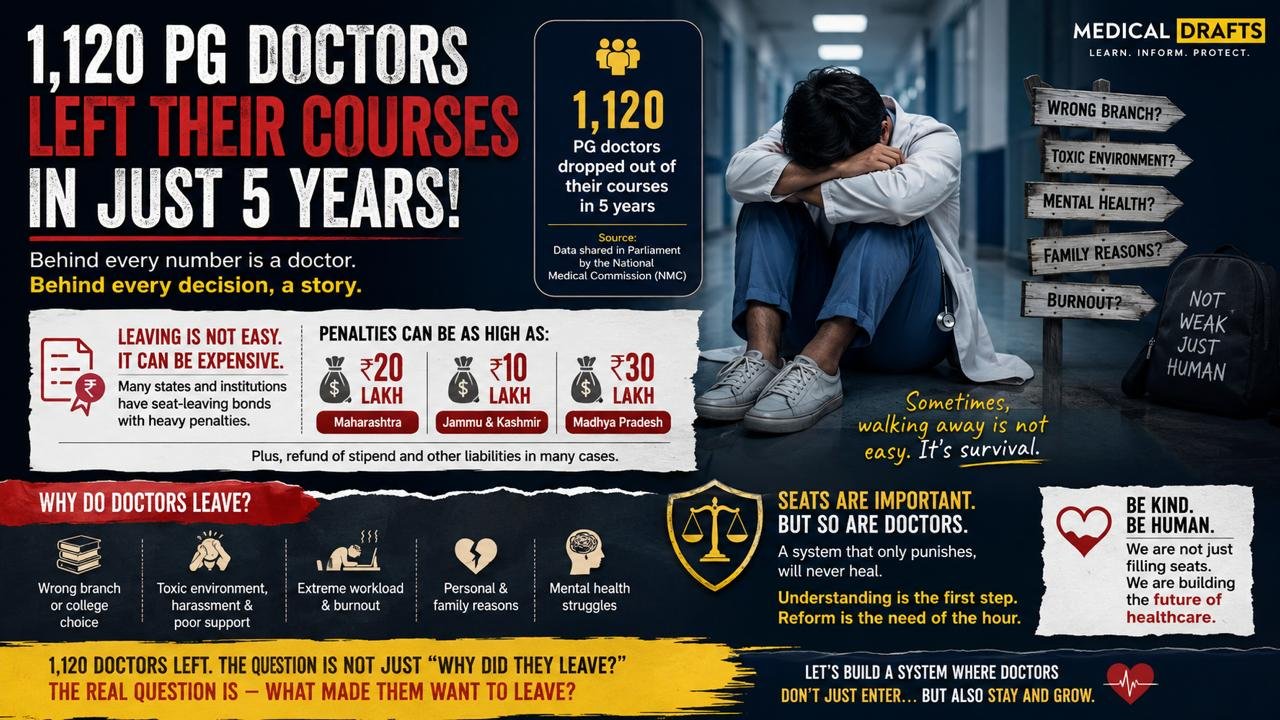
Postgraduate medical education in India is facing a disturbing reality that is often hidden behind numbers of seats, ranks and counselling rounds. According to data attributed to the National Medical Commission (NMC), 1,120 doctors pursuing postgraduate medical courses dropped out of their institutions over a period of five years. This means that more than a thousand doctors who had already secured highly competitive MD, MS or other PG seats ultimately chose to leave their courses. The figure becomes even more significant when we remember that these are not ordinary college admissions; these are doctors who have already completed MBBS and gone through one of the country's most competitive entrance examinations.The situation becomes more complicated because leaving a postgraduate seat is not always a simple decision. In several states, candidates are required to sign seat leaving bonds, under which they may have to pay substantial penalties if they discontinue their course. For example, Maharashtra had a ₹20 lakh seat-leaving penalty, while admission documents of government medical colleges in Jammu and Kashmir provide for a ₹10 lakh penalty plus refund of stipend if an MD/MS resident leaves the course midway. AIIMS New Delhi has also considered increasing its discontinuation penalty for PG courses after noting that students leaving midway can leave seats vacant and cause financial losses to the institution.But the most important question is: how many of these 1,120 doctors actually paid the penalty? At present, there does not appear to be a publicly available, consolidated national figure answering this question. The NMC figure tells us the number of PG doctors who dropped out, but not how many paid a seat-leaving fine, how much money was collected, or how many were able to leave without paying because of court orders, policy changes or differences between states. There are, however, documented individual cases where doctors have paid significant amounts. In one reported case, a postgraduate doctor paid ₹5 lakh after leaving a course, while another case before the Supreme Court involved a ₹30 lakh seat-leaving bond imposed on a PG doctor in Madhya Pradesh.The numbers should therefore make us ask a larger question. Why are so many doctors leaving postgraduate training after spending years preparing for a PG seat? The reasons can range from choosing the wrong branch or college to unbearable workload, poor working conditions, harassment, inadequate clinical exposure, personal circumstances and mental-health difficulties. Maharashtra alone reported 85 postgraduate medical students discontinuing their studies in five years, according to state medical education department data. The same debate has prompted resident doctors' organisations to demand reconsideration or abolition of seat-leaving penalties, arguing that financial penalties can make residents feel trapped in an unsuitable or harmful training environment.A postgraduate medical seat is undoubtedly valuable, and repeatedly leaving seats can disrupt counselling and deny another candidate an opportunity. But a system designed to prevent wastage of seats must also recognise that a doctor is not a machine locked into a three-year contract. Before imposing penalties running into lakhs of rupees, there should be a transparent mechanism to examine why a resident wants to leave and whether the circumstances are genuine. The fact that 1,120 PG doctors reportedly dropped out in five years should not merely be treated as a problem of vacant seats. It should trigger a deeper examination of what is happening inside postgraduate medical training. The real question is not only “Why did they leave?” but also “What made them want to leave in the first place?”